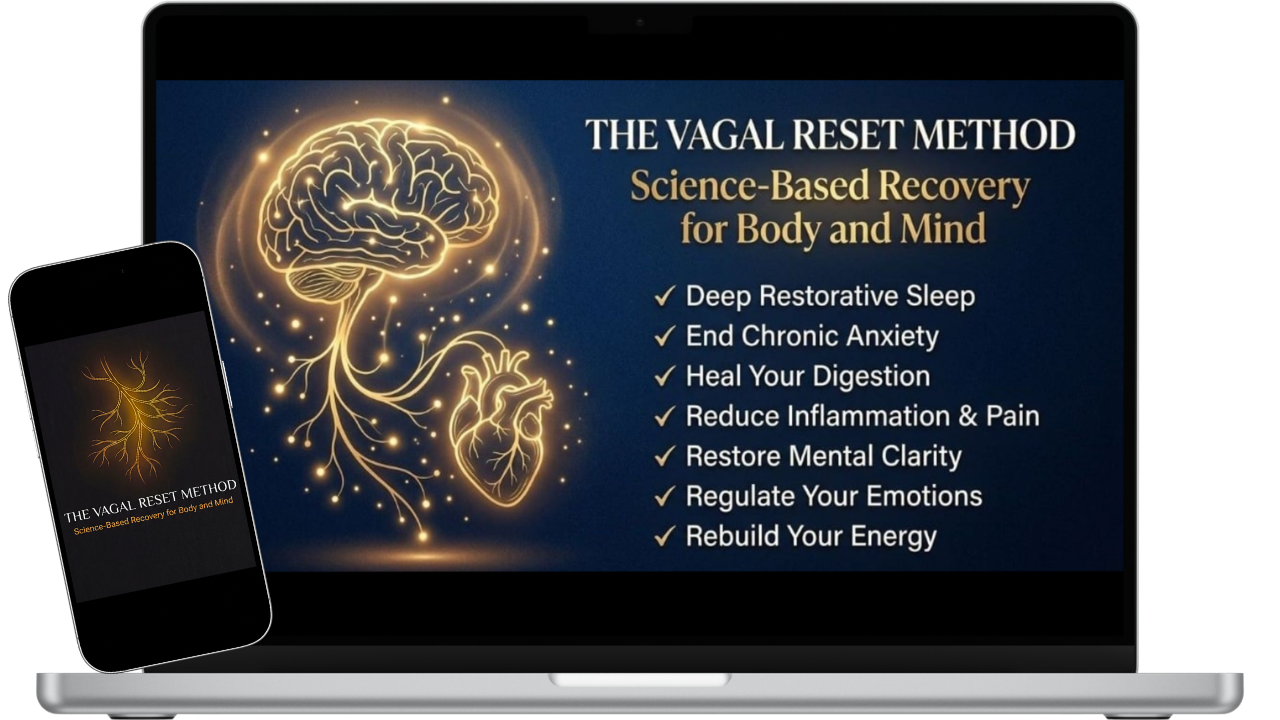
A science-based daily protocol that rebuilds your nervous system from the inside out — so you can sleep deeply, end the wired-but-tired loop, calm your gut, and feel safe in your own body again.
Start The Reset Tonight →
You wake up tired even after eight hours of sleep. Your heart races for no reason. Digestion feels off. Anxiety shows up without warning.
You've tried the supplements. The meditation apps. The breathwork videos. Maybe even therapy. Some of it helped a little. None of it stuck.
This nerve is the master regulator of your rest-and-repair system. When it works properly, you sleep deeply, digest easily, recover quickly, and feel calm under pressure. When it stops working properly, everything falls apart — slowly at first, then all at once.
You can remove stressors, take vacations, change jobs, end relationships, and still feel stressed — because the underlying mechanism is impaired. Conversely, you can face significant challenges while feeling relatively calm if your nervous system can shift gears.
The vagus nerve influences so many systems that its dysfunction shows up in seemingly unrelated symptoms. Most people are diagnosed with five different conditions when they really have one underlying problem.
You feel wired even when exhausted. Relaxation feels uncomfortable or even dangerous. When you try to meditate, your mind races faster.
You struggle to fall asleep, wake frequently, or feel unrested after eight hours. Deep sleep requires parasympathetic dominance — without strong vagal function, you skim the surface.
Bloating, constipation, acid reflux, or feeling full after small meals. Many people with vagal dysfunction are diagnosed with IBS or SIBO.
Elevated resting heart rate. Heart pounding during minor stress. Slow recovery after physical exertion. The vagus nerve is the primary brake on your heart rate.
Anxiety without clear triggers. Difficulty recovering from emotional upsets. Small frustrations feel like catastrophes. This is not weakness — it's a nervous system stuck in threat mode.
Restaurants feel too loud. Grocery stores feel too bright. Your threshold for stimulation has dropped because your system is already maxed out.
The vagus nerve is the longest nerve in your body. It begins at the base of your skull and wanders through your neck, heart, lungs, stomach, intestines, liver, and dozens of other organs. The name vagus is Latin for wanderer.
Vagal tone is not fixed like your height or eye color. Through specific, daily practices — backed by HRV measurement — your vagus nerve becomes stronger and more responsive over time.
This means the wired-but-tired feeling, the anxiety, the broken sleep, the gut chaos — none of it is permanent. It's a trained nervous system, and it can be retrained.
"Do not underestimate this practice because it seems simple. The research is unambiguous."
The breathing rate that produced greater vagal activation than meditation or mindfulness without a breathing component.
Reduction in interleukin-6 (a key inflammation marker) within one hour of a 20-minute chest-level vibration session at 25 Hz.
Stephen Porges revealed the vagus nerve isn't one system — it has two distinct branches. The newer one is what you train.
Heart rate drop within seconds when cold water hits the face — one of the most powerful vagal activators known to science.
Each pillar targets a specific physiological pathway. Together they compound — which is why the protocol works when individual techniques don't.
The most powerful and accessible vagal activator. Slow diaphragmatic breathing directly stimulates the vagus nerve through multiple mechanisms — diaphragm expansion, extended exhalation, and rhythmic coherence.
Low-frequency vibration physically stimulates the vagus nerve through the chest wall. The same frequencies cats use to heal — and that NASA used to prevent astronaut bone loss.
Cold water on the face triggers the dive reflex — heart rate drops 10-25% within seconds. Done daily, it trains your nervous system through hormesis: small, controlled stressors that strengthen the vagal response.
The vagus nerve does not rebuild in isolation. Gut health, sleep architecture, and meaningful social connection directly strengthen vagal pathways — or actively erode them.
The protocol is sequenced. Each phase builds on the previous one. You'll know exactly what to practice, for how long, and what to expect at every stage.
Establish your breathing practice and begin introductory humming. The focus is learning the techniques correctly and building consistency — not chasing dramatic effects. You may feel nothing dramatic this week. That's normal.
Add cold exposure. Extend duration of breathing and humming. This is when most people start noticing easier transitions to calm, improved sleep onset, and a general sense of being less reactive.
Integrate all four pillars into a seamless daily routine. The shift from learning techniques to refining sensitivity. Calm starts to become your baseline rather than something you have to achieve.
A sustainable, long-term practice that maintains vagal function without requiring excessive time or effort. The benefits become your new baseline — calm is no longer something you achieve. It's something you return to.
Real nervous-system change is biological. It compounds. Here's the honest timeline.
You may feel nothing dramatic. You might even feel more aware of your anxiety or tension. This is normal — you are developing sensitivity to your internal state for the first time in years.
Most people notice easier transitions to calm, improved sleep onset, and a general sense of being less reactive. Humming reliably produces a calming effect. You might yawn during practice — a sign of parasympathetic activation.
The benefits become your default state. The calming effect feels effortless. Chest resonance is easy to find and sustain. Sleep is no longer a struggle. You don't have to try to be calm.
Not vague advice. Not spiritual platitudes. Specific, science-based techniques and the biology behind why each one works.
What the vagus nerve is, where it lives, and why 80% of its signals go from body to brain.
Why the sympathetic-parasympathetic balance is the key to everything else — and how it breaks.
Heart Rate Variability, what high vs. low vagal tone feels like, and why it's the most predictive health metric.
Chronic stress, inflammation, trauma, and poor breathing. The four root causes — and what to do about each.
The full symptom map — including the ones doctors miss because they look unrelated.
Stephen Porges' framework. Why "just relax" doesn't work and what your nervous system actually responds to.
Kevin Tracey's discovery — how vagal activation directly reduces systemic inflammation.
Why you cannot fully heal one without the other. The microbiome's vagal feedback loop, decoded.
The mechanisms: diaphragm expansion, extended exhalation, rhythmic coherence.
The cat purr discovery, NASA's vibration platforms, and why humming reaches the same frequency.
The dive reflex, the trigeminal pathway, and how to use cold without the trauma of an ice bath.
Why time with safe people physically rebuilds vagal pathways. The biology of co-regulation.
How the four pillars fit together and the 8-week phasing that ensures real change.
Step-by-step instructions, the four most common mistakes, and the extended-exhale variation.
Position, pitch, duration, and three powerful variations including Bee Breath (Bhramari).
You get the complete book, the daily protocol, and every variation — all delivered as an instant PDF you can read tonight.
Symptoms typically resolve in a predictable order — sleep, then digestion, then emotional regulation, then chronic inflammation. These results follow that pattern.
"I'd been a 'light sleeper' for years — convinced it was just my personality. By week three I was sleeping through the night for the first time since my thirties. The breathing protocol alone changed something I thought was permanent."
"Two specialists, three years, every probiotic on the market. Diagnosed with IBS, treated for SIBO, never resolved. Six weeks into this protocol my bloating was gone. The gut-brain explanation finally made sense — I wasn't broken, I was wired wrong."
"What got me was the framing. 'You're not stressed because of your circumstances — your brake is broken.' That hit. I'd been changing jobs, partners, cities, looking for the cause. Turns out the cause was internal. Six weeks of humming and breathing and I haven't had a panic attack in two months."
"I was skeptical of the cold-water-on-the-face thing. It sounded too simple. Three weeks in and I can shift out of a stress spiral in under a minute. That's not a wellness platitude — it's a measurable change in how my body responds to stimulus."
"The science section is what made me trust the protocol. I'm a research scientist by training and I needed to see citations, not vibes. Polyvagal theory, the Feinstein Institute work, the Stanford breathing study — it's all there. And then the techniques actually work."
"Fifteen years of autoimmune flares. Inflammation markers chronically elevated. I added humming to my morning practice and breathing twice daily — that's it. My latest CRP came back normal for the first time in a decade. I have a paper trail. This is real."
Read the entire book. Try the breathing protocol. Try the humming. If, within 7 days, you don't feel something has shifted — even slightly — email us and we'll refund every cent. You keep the book. The risk is fully on us.
You can keep trying supplements. You can keep waiting for the next breakthrough therapy. Or you can spend less than a takeout meal and learn the protocol that addresses the actual mechanism — the one no one ever told you about.
Get The Method — $14.97 →No subscriptions. No catch. The exact same book — at a one-time launch price for first-time visitors. Five minutes of breathing tonight is where the reset starts.
No thanks, I'll pay full price later